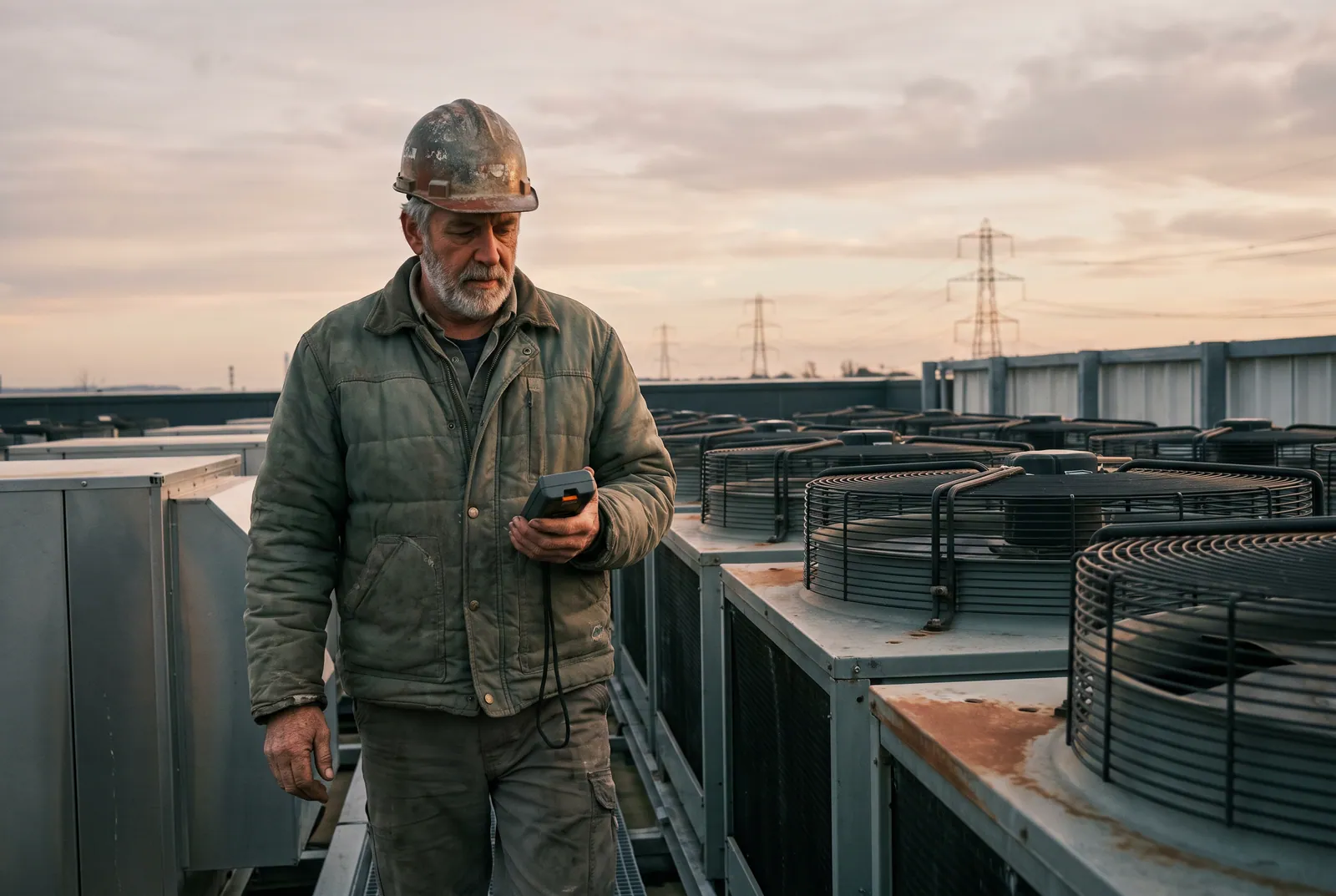
Physical AI is artificial intelligence that perceives, reasons and acts in the physical world, through robots, vehicles, sensors and machines. Deloitte’s Tech Trends 2026 describes machines that autonomously “perceive, understand, reason about, and interact with the physical world in real time”. The base is already large: 4,664,000 industrial robots were operating in 2024, according to the IFR (2025).
What is physical AI, exactly?
Most AI people use today produces text, images or code. Physical AI produces an action: it moves an arm, stops a conveyor, steers a vehicle or opens a door. That difference changes the engineering, because a wrong answer becomes a wrong movement.
Every physical AI system runs the same loop:
- Sense: cameras, lidar, force sensors or meters capture the state of the world.
- Interpret: a model turns raw signals into objects, positions and events.
- Decide: the system chooses an action within its rules and limits.
- Act: a motor, valve, lock or vehicle carries out the action.
- Verify: sensors confirm the result, and the loop starts again.
The idea has moved from research to strategy. Gartner listed physical AI among its top strategic technology trends for 2026, published in October 2025.
Examples of physical AI
- Adaptive industrial robots that adjust grip and path when parts vary.
- Autonomous mobile robots that move goods through warehouses and plants.
- Visual inspection on production lines, where cameras flag defects as they appear.
- Smart access control, where a door decides based on identity, schedule and zone.
- Energy and building systems that adjust equipment to measured demand.
- Humanoid robots, still early, designed to work in spaces built for people.
How big is physical AI today?
Industrial robots are the most measured part of physical AI. Humanoid figures are projections, cited here only as Deloitte reports them.
| Indicator | Figure | Source |
|---|---|---|
| Industrial robots installed in 2024 | 542,000 | IFR, World Robotics 2025 |
| Industrial robots in operation, 2024 | 4,664,000 (+9%) | IFR, World Robotics 2025 |
| China’s share of 2024 installations | 54% (295,000 units) | IFR, World Robotics 2025 |
| Installations forecast for 2025 | 575,000 | IFR, World Robotics 2025 |
| Installations forecast for 2028 | More than 700,000 | IFR, World Robotics 2025 |
| Humanoid robots projected by 2035 and 2050 | 2 million and 300 million | UBS, cited by Deloitte (2025) |
| Change in humanoid robot costs, 2023 to 2024 | 40% decrease | Goldman Sachs, cited by Deloitte (2025) |
The installed base keeps growing, and the IFR expects more than 700,000 installations a year by 2028. Each of those machines is a candidate for more perception and more autonomy.
Why does physical AI need edge computing?
A machine that acts in real time cannot wait for a distant data center. A robot arm near a worker, or a door at a secure entrance, must decide within the moment it is acting.
Three reasons push decisions to the edge:
- Latency. A round trip to the cloud adds delay that a moving machine cannot afford.
- Continuity. The site must keep operating safely when the connection drops.
- Data volume. Cameras and sensors produce more data than is sensible to send everywhere. Most of it is useful only locally.
Cost is less of a barrier than it was. The Stanford AI Index 2025 reports that the price of inference fell from $20 to $0.07 per million tokens. That happened between November 2022 and October 2024. That is a more than 280-fold drop.
A useful split is simple: decide at the edge, learn and govern centrally. The edge runs the loop. The center trains models, sets policies and keeps the full record.
Why do sensors and data quality matter so much?
A model can only act on what its sensors report. A camera with a dirty lens, a drifting temperature probe or a clock out of sync produces decisions that look confident and are wrong.
In practice, teams need calibration routines, health checks on each sensor and consistent timestamps across devices. They also need to keep the raw events, not only the conclusions. When something goes wrong, the question is always the same: what did the machine see, and what did it decide?
Why does device identity become critical?
Every robot, camera, gateway and controller authenticates, receives commands and holds secrets. Each one is a machine identity.
The CyberArk 2025 Identity Security Landscape found 82 machine identities for every human. It also found that 42% of machine identities had privileged or sensitive access. And 68% of organizations lacked identity security controls for AI.
The OWASP Non-Human Identities Top 10 lists the usual failures. They include improper offboarding, secret leakage and long-lived secrets. In software, a leaked key exposes data. In physical AI, a leaked device credential can move a machine or open a door.
How should safety be designed?
Safety in physical AI works in layers, and the model is only one of them:
- Hard limits outside the model: emergency stops, interlocks, speed and force ceilings that no model output can override.
- Human approval for high-risk actions: a person confirms actions above a defined risk threshold.
- Complete records: each sensor reading, decision and action is logged so any incident can be reconstructed.
Regulation follows the same logic. The EU AI Act treats AI embedded in products covered by EU product-safety law as high-risk. After the 2026 amendment approved by the European Parliament, those obligations apply from 2 August 2028. This is not legal advice.
A practical checklist to start with physical AI
- Choose one physical process with a clear metric, such as scrap rate, downtime or access incidents.
- Audit the sensors first. Fix calibration, coverage and timestamps before training any model.
- Decide what runs at the edge and what stays central, based on latency and safety.
- Give every device an identity, rotate its secrets and remove it cleanly when it is retired.
- Set hard safety limits outside the model, and define when a person must approve.
- Record every event: reading, decision and action, with time and device identity.
- Pilot in a bounded zone, measure against the baseline and expand only when the metric improves.
How we see it at Blackwood
Blackwood Stone Holdings is an applied research and development company specialized in artificial intelligence and advanced engineering, founded in 2009. We see physical AI as a systems problem. The model matters, but so do edge hardware that keeps working offline, device identity and a record of every action.
That is why we expect early results in settings such as advanced manufacturing, where processes are measured and sensors already exist. We have written about why companies fail to scale AI and about treating identity as an operable layer. Both lessons apply with more force when AI can move things.